After a few days of attention on the killing of Osama bin Laden by US Navy Seals, I may have some perspective on the event. First, I've heard some people complain that Pres. Obama is trying to take political advantage of the military victory. This complaint is off base for many reasons -- first of all, someone had to make the gutsy decision to order the operation to be carried out. Victory in this operation was not a foregone conclusion, as the President's national security aides have pointed out. Second, the President's job is to take victories like the one our military and intelligence community just had and use them to the US's advantage in foreign and domestic arenas. A full court press in domestic and international media is necessary at this time, with the anniversary of September 11 certain to dominate press coverage in the months ahead, and with Al Qaeda finally dealt a substantial blow. It's not only appropriate but also good strategy to go on offense, as opposed to simply playing defense, after something like this happens. Now, the President doesn't want to overplay his hand, which is another reason why NOT releasing the photos of a dead Osama bin Laden was a good decision. But I think he's playing this with his trademark calm, and it's important that he appear in control of the situation at this time.
It's good to see Osama bin Laden brought to justice. With that said, the Lord says, "Vengeance is mine." Let's not get carried away with the swell of patriotism and forget that the Lord counsels restraint in times of turmoil. The Lord certainly had a hand in bringing Osama bin Laden to justice, but he doesn't really take sides in war. He knew September 11 was going to happen when he was hanging on the cross, and he allowed it to happen, along with a thousand other daily atrocities around the world. God is the ultimate source of justice in this world and the next, and we all fall short of God's glory. So, give praise where it is due, but remember, God is in control.
Showing posts with label Middle East. Show all posts
Showing posts with label Middle East. Show all posts
Friday, May 06, 2011


Monday, April 05, 2010
An emotional response
I saw a video yesterday of someone in Iraq carrying a wounded child away from a bombing, and my heart went out to that person. The video was about 3 seconds long -- just long enough to convey the anxious look on the man's face as he passed the camera. Then I read today about bombings in Pakistan and heard a follow-up report analyzing the bombs in Iraq. My emotional response is to think, "When will all this senseless violence end?" The Muslim world must have some kind of response to this terrible news, but all the formal diplomatic responses and blame-shifting must be some small comfort to that man in the video. Our news has a "bomb of the day" aspect to it -- it is unsettling to focus on the human tolls of these tragedies, so our news doesn't dwell on them. But that one man in the news clip conveyed the ache that must be in the hearts of so many who see the same thing, day in, day out, repeated over and over again -- the violence that rips apart societies and individual lives; the poverty and despair of so many people in the Muslim world and around the world. I know that if I had to endure the pain of the world for one second, it would be so unbearable that it would crush me in an instant. That's part of what makes Jesus' sacrifice on the cross so amazing. Jesus took on human flesh and bone and endured pain and suffering that is indescribable in physical terms. But the spiritual pain of having the sins of the world thrust upon his shoulders, including things like 9-11 and the bombings I just mentioned -- must have been even more indescribable. The kicker in all this is that he didn't do it because we deserved it -- he did it while we were still sinners so that we could live. And he is waiting, (waiting!) for the remnant of the world to be saved, enduring all this spiritual pain still, so that we can have a chance to reach more people for him.
Tuesday, January 05, 2010
"The CIA gets what it needs"
Which President told his advisors, "The CIA gets what it needs," Obama or Bush? According to this long article in the NYT Sunday Magazine, it was Obama. He has authorized 53 drone attacks on "high-value targets," (more in one year than in Bush's entire Presidency) as well as a helicopter attack in Somalia, next door to Yemen. Which brings me to this interesting quote referring to "Obama's two wars" -- against Al Qaida and within the U.S. -- and how Yemen has become a focus for both of them.
Yemen in many ways is where Obama’s two wars come together. It is a breeding ground for extremism, the home of the radical cleric who inspired Maj. Nidal Hasan before he opened fire at Fort Hood last fall and, the president has stated, the origin of the Christmas Day bombing plot involving Umar Farouk Abdulmutallab. At the same time, it is the place where roughly half of the remaining detainees at Guantánamo come from, making it the central focus for efforts to close the prison.The Obama administration certainly has its hands full in fighting off terrorism both internationally and in the U.S. I pray against enemies within and without in these dangerous times.
Monday, January 04, 2010
Yemen and Saudi Arabia
Saudi Arabia has a role to play in the ongoing battles in the Middle East, but I've never really pictured the country as a vulnerable, failed or failing state. That seems to be part of Al Qaeda's goals or thinking, though, at least according to a comment from a Yemeni professor that might raise some eyebrows:
The quote comes from this article on Yemen's leader and his family in the New York Times. The professor may be analyzing the economic situation more than the political, or he may be overstating his case. It sounds like he's saying that one of Al Qaeda's aims in all this is to take down the Saudi government.
With oil revenues down, Mr. Saleh [the leader of Yemen] has had to turn to outside allies to help finance the war in the north. Saudi Arabia provided $2 billion last year to make up for the budget shortfall — an amount that dwarfs the $150 million in security assistance that the United States will ask Congress to approve for the 2010 fiscal year.
“The Saudis understand,” said Ahmed M. al-Kibisi, a political scientist at Sana University, “that they are the real prize for Al Qaeda, and Yemen is the platform.”
The quote comes from this article on Yemen's leader and his family in the New York Times. The professor may be analyzing the economic situation more than the political, or he may be overstating his case. It sounds like he's saying that one of Al Qaeda's aims in all this is to take down the Saudi government.
Sunday, January 03, 2010
Engagement in the Middle East
After reading a few articles on Yemen (New York Times, Washington Post), the home of the camps where the underwear bomber was apparently trained and equipped, and the President's speech in Cairo in June, I have a few thoughts on how best to engage the Middle East. In the summer, when Pres. Obama made the speech, it was hyped a little in the western world and downplayed, so far as I can tell, in the Middle East. Pres. Obama spoke a little bit like an Islamic scholar, scolding some of the countries of the Middle East for various policies, but maintaining a respectful attitude toward the religion and emphasizing the need for interfaith dialogue, as well as referring to some Islamic stories and the Koran. The President emphasized respect for Islam in the U.S. and freedom of religion as an example to the Muslim world. I don't know how much this solved any problems, but it at least gave anyone listening some facts to chew on as to whether the U.S. is the monolithic imperial power that some Islamic countries (Iran) like to make us out to be.
Wednesday, August 05, 2009
More Bad News from Pakistan
Here's another story about the perversion of justice in Pakistan. Brave, good reporting from the New York Times that should raise the level of interest in human rights there. Pakistan is an ally, because "the enemy of my enemy is my friend." But Pakistan is hardly a democratic country where the rule of law is primary. Let's hope things change there, and soon, so that we don't end up with another failed state -- this time with nuclear weapons in the arsenal of whatever thugs manage to cling to power.
By the way, Afghanistan hasn't been doing so great on human rights recently, either.
By the way, Afghanistan hasn't been doing so great on human rights recently, either.
Monday, August 03, 2009
Grim Stories from Pakistan
These two reports show how dangerous life can be in Pakistan, whether you are a Christian or an insurgent:
Christians burned in own home
Swat Valley not exactly returning to normal
Those are my headlines, but they suit the stories well enough. These stories probably ran in the back pages of the New York Times' print edition, but they are worth paying attention to. Pakistan is our ally in the war on terror, but it's a fragile alliance that doesn't reach down far enough to become a security arrangement for the people of Pakistan. Someone needs to look out for these vulnerable people to tell the government and militant imams not to take advantage of the poorest among them.
Christians burned in own home
Swat Valley not exactly returning to normal
Those are my headlines, but they suit the stories well enough. These stories probably ran in the back pages of the New York Times' print edition, but they are worth paying attention to. Pakistan is our ally in the war on terror, but it's a fragile alliance that doesn't reach down far enough to become a security arrangement for the people of Pakistan. Someone needs to look out for these vulnerable people to tell the government and militant imams not to take advantage of the poorest among them.
Friday, July 03, 2009
"Business as Usual" in Iran
This background story appeared a couple days ago on the BBC website. I think it's useful to those of us who are just now "learning our enemy" in Iran. An Iranian cleric is now calling for a trial of British embassy employees - possibly 1 or 2 -- who are accused of meddling in Iranian politics and fomenting the protests over the disputed election.
Thursday, July 02, 2009
From the Horse's Mouth
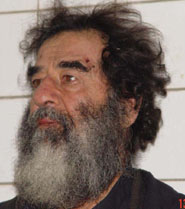
No, I'm not talking about Mr. Ed, but rather, Saddam Hussein, who apparently had 20 interviews and 5 "casual conversations" with the FBI before he was executed in 2006. An editorial summary of the interviews can be found here -- pretty hard evidence that, at least from Saddam's perspective, there were no WMDs, there was no link to al Qaeda, and that the dictator was more concerned with Iran than the U.S. before the final invasion that ended his career. It's an interesting read for those who are interested in the first draft of history. Also, Saddam's ego comes through in the pages of the interviews.
Saturday, May 31, 2008
"Iran & Friends" vs. "Silly" Americans?
I don't often agree with Thomas Friedman, but his column here makes a good case for how to move forward in foreign policy. I don't think Friedman is 100% right -- I think the U.S. has more pull in the Middle East than he thinks we do. Still, he has a point. Maybe Obama should talk more about pulling off a peace deal between Israel and the Palestinians than he has to this point.
Subscribe to:
Posts (Atom)