Showing posts with label history. Show all posts

Friday, March 18, 2011

Historical Note - 25 years ago this week, Microsoft went public

I found this article while browsing late tonight.  It's interesting to note how much has changed in 25 years, both because of and in spite of Microsoft, and how much hasn't.  It's also interesting to see how Microsoft came to be so admired and respected -- it wasn't out of greed, necessarily, that Gates took Microsoft public, but rather, because it was demanded of the company in order to attract and keep "excellence."

I like the cover art, too - very 1980s to focus on the dollar signs.

Anyway, if you're interested, check it out!

Saturday, September 11, 2010

Reflections on September 11

My parents were supposed to fly on September 11, 2001, and my wife's parents flew over the burning buildings on their way to Boston that day.  They landed at Logan Airport, where two of the planes had taken off from, and saw first-hand a small portion of the chaos that day touched off.  My parents ended up driving home from Colorado, and were safe at home soon, but the eerie silence of no planes in the sky is one haunting memory from that day.  I also remember being on top of the World Trade Center not that long before -- 1996 or so -- and thinking the building served like an urban park.  I want to remember some of these things because they are gone now, and politics have become the focus on a day that is still raw with emotion for many people.  People who haven't lost anyone in particular seem more political than the actual victims' families, although the families too are politicized in their fight to keep the memory of the victims alive.  It seems there's no avoiding divisive ideas like book-burning and cultural centers near hallowed ground, but those fights seem trivial compared to the loss of life and collective innocence on that day.  My own memories are shaped by personal and political views, but I know that September 11 ought to be remembered as a day when many people lost their lives at the hands of a murderous few.  The courage of those who fought back and rushed to the aid of victims should also be remembered.  Slogans like, "Never forget," remind me of the destruction of European Jews under the Nazis -- Holocaust survivors' slogan is "never again" -- and seem designed to promote a certain view of patriotism.  There is little value in comparing tragedies in terms of number or impact on world events, but September 11 will be remembered as a turning point in world history, not only because of the wars that were launched as a result of the attacks but also because of the collective blow to the U.S's sense of security.  The end of the 20th Century is somewhat euphoric in comparison to our current fears and concerns -- there was talk of "the end of history" as I was going through my college years.  The idea was that the spread of democracy around the world had made the world so safe that history as we knew it would gradually cease to exist.  We now know that prediction did not come true. 

Monday, February 01, 2010

Civil Rights, Change, and the Sit-in's 50th Anniversary

From a three-volume history of the "King years" I've been slowly making my way through:
"No one had time to wonder why the Greensboro sit-in was so different.  In the previous three years, similar demonstrations had occurred in at least sixteen other cities.  Few of them made the news, all faded quickly from public notice, and none had the slightest catalytic effect anywhere else.  By contrast, Greensboro helped define the new decade.  Almost certainly, the lack of planning helped create the initial euphoria.  Because the four students at Woolworth's had no plan, they began with no self-imposed limitations.  They defined no tactical goals.  They did not train or drill in preparation.  They did not dwell on the many forces that might be used against them.  Above all, they did not anticipate that Woolworth's white managers would -- instead of threatening to have them arrested -- flounder in confusion and embarrassment.  The surprise discovery of defensiveness within the segregated white world turned their fear into elation."
The Greensboro sit-ins galvanized the civil rights movement -- 4 students without a plan turned into more than 80, and the sit-in spread to other cities in North Carolina and gathered momentum as it went. The spontaneous demonstration of the illogic of the segregation laws gave powerful proof that people would respond to the ideas that had been percolating in the South for some time.  I'd like to think there was a direct line between the events of 50 years ago (today) and our present difficulties, but I know it's much more complicated than I can probably address here.  There are still people who oppose change, even democratic change (small "D" there) that comes from the ground up. The "Tea Party" protests may be "grass roots" to an extent, but they are also motivated in part by political gamesmanship played in Washington, D.C.  The history I've read shows that there was no shadowy political organization behind the sit-ins, no "profit motive," as some have accused the Tea Party groups of having.  The organization that was there in the 1960's capitalized on the momentum the sit-ins generated, to be sure, and there was a group of students who emerged as leaders in the movement around the sit-ins.  But times were different, and the need for change was real.  Now, President Obama may be styling himself as a change agent, and I hope that he becomes a real change agent in Washington.  But real change from the bottom up has more to do with societal change than it does with elections and politics.  Real change in society comes when people are willing to sacrifice something, when people meet up with other like-minded people and express not just outrage but also constructive ideas for how things can be made better.  Non-violence was one such constructive idea.  More later, perhaps...

Monday, January 18, 2010

Why Martin Luther King, Jr. Matters

I've heard two competing versions of Dr. Martin Luther King Jr.'s meaning this long weekend -- one from my pastor and one from this column in the New York Times.  The pastor, understandably, claimed Dr. King as a hero of faith, quoting one of his last sermons about seeing the promised land from the mountaintop.  The column claims Dr. King as a fighter for economic justice, in addition to civil rights.  Both of these views have some support in the history I've read on the subject of "the King years" -- I've read the first volume and a little bit of the second of a three-volume history by Taylor Branch.  The emphasis in the history, though, is on the struggle itself, not so much attempting to claim Dr. King as part of one camp or another.  The civil rights story is very much a human story, filled with hate and mistakes and questing for something better, groping for answers in the face of overwhelming obstacles.  The "I Have a Dream" speech, as much as it was a triumph, was also the beginning of a long, political campaign, similar to a war in all its fits and starts.  And Dr. King was a leader who galvanized the battle on both sides, bringing the situation to a head with his stand against violence and for human rights.  Dr. King's character was not saintly, but it was principled, and it is his struggle for something better in human nature and in the real world of politics and everyday life that is worth remembering.  Dr. King demonstrated the force of moral action in the face of ruthless hatred and ignorance, and he ultimately helped millions of people overcome those fearsome obstacles.  So he is a good example for us as Christians, and it is important to see him as someone who was concerned with economics as well as more abstract forms of justice, but more than both of those ideas, I see him as a symbol of humanity's struggle for meaning in a world that would deny us all some of those chances at meaning if it could.

Wednesday, December 30, 2009

Year-End Hysteria (Bring Back the Millennium Bug!)

The end of this year brings to mind some of the end-of-year hysteria that accompanied the turn of the millennium. People generally are woefully misinformed, and I have heard many opinions expressed at the end of this year, without a ton of facts to support them. The attempted bombing in Detroit did rattle me personally a little bit, with some direct ties between my dad's job and the events in the news. I worried for him and for my mom, who worries already about dad's safety. But I'm trying not to leap to conclusions, especially about Nigeria, Yemen, and these "new threats" despite the best efforts of the media to raise interest levels in threat assessments, wars, and other "exciting" news. The speculation at the end of 2000 was that something catastrophic would happen due to computer dates not being set correctly. That fear seems quaint after the events of 9.11.2001, but I hope the new mindset of the U.S. being at war with "Islamic extremists" does not result in more hatred. We seem to be in a cycle of violence based on fear and misunderstanding on both sides. The reaction of Fox News to the attempted bombing has been to inflame already aggravated emotions. I know because my father-in-law was watching Fox News on Christmas Day, and his opinion has been set by their drumbeat demands that the President label "the enemy," together with his natural conservative leanings. An antidote to this may be to hope for something better in the future, focus on family and friends and keep trying to learn more about the people in these countries than can be reported in the media.

Wednesday, July 08, 2009

The Fog of War

I'm posting tonight about Robert McNamara, about whom much has already been written. I saw the documentary Fog of War, based on interviews with Mr. McNamara, a few years ago, and I don't know that I got all the way through it. Still, it painted an interesting picture of the way Mr. McNamara justified his actions years after the fact -- the "fog of war" may be something he never escaped. I love the phrase "fog of war" but think it might just cover over some of the worst atrocities that have been committed in the name of nations and states. I hope someday we will see our way through to becoming a less bellicose nation.

Thursday, July 02, 2009

From the Horse's Mouth

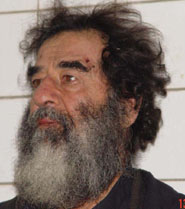
No, I'm not talking about Mr. Ed, but rather, Saddam Hussein, who apparently had 20 interviews and 5 "casual conversations" with the FBI before he was executed in 2006. An editorial summary of the interviews can be found here -- pretty hard evidence that, at least from Saddam's perspective, there were no WMDs, there was no link to al Qaeda, and that the dictator was more concerned with Iran than the U.S. before the final invasion that ended his career. It's an interesting read for those who are interested in the first draft of history. Also, Saddam's ego comes through in the pages of the interviews.

Thursday, June 11, 2009

History Mystery

Mr. Hitchcock of Temple University remains unconvinced that there is a zero-sum game however. “How will we write the history of the Iraq war?” he asked. Social pressures, differing cultural and intellectual assumptions will all be included, he said: “We’ll widen our frame of reference, while not losing sight of the remarkable fact that a very small number of people still have the power to lead nations into war.”


I found the quote above in this article on history programs at universities from the New York Times. The article's thesis is that history programs are shifting emphasis away from diplomatic history to more socially acceptable fields like "people's history." What do y'all think?

Tuesday, November 04, 2008

History

Four American ideals Obama mentioned in his speech tonight struck me: "democracy, liberty, opportunity, and unyielding hope." His election does indeed represent those qualities of the United States -- democracy because it represents the will of the people, liberty because those rights we all take for granted were expressed, opportunity because a Black man can become President, and hope because he did it with a positive message. I've taken some flak in recent days for having "buyer's remorse," and I do have some qualms about Obama's stance on abortion in particular. But I don't doubt that this election has given us as a country a chance to start believing in some of those core principles in new ways. And John McCain was eloquent in defeat. He didn't exploit racial fears and bigotry in his campaign, and I applaud him for that. He ran a principled campaign, just as much as Obama did. And for all the attacks and counter-attacks, the question came down to who best represented change. Obama successfully argued that a McCain presidency would mean more of the same, while painting a picture of how he would represent change. Now it remains to be seen whether that change will be carried out.

Saturday, August 25, 2007

Presidential Traits

Here's a quote from Meet the Press about traits people look for in Great Presidents, according to a noted historian:
"Doris Kearns Goodwin, you’ve been thinking and writing and talking about attributes, traits that we look for in our commander in chief, our presidents. And this is the list so far, a work in progress: They have withstood adversity, they have diverse perspectives around them, they have a sense of loyalty, they’re not afraid to admit mistakes, they know how to manage their emotions, they can define the goals for the country, and they know how to relax."

I'm not sure I agree on everything. The traits of a great President, in my book, include: a clear sense of direction that guides policy and overrides personality; Biblical values that are expressed in unconventional policy decisions and a strong commitment to faith in one's personal life; humility; oratorical skill. I agree on withstanding adversity, admitting mistakes, having diverse opinions around them, and goals, but loyalty, managing emotions, and knowing how to relax don't fit the bill to me. Loyalty can be a fault in a great politician -- it depends who or what the person is loyal to. Managing emotions seems like so much psychobabble to me. Every President will have to handle their emotions, but what does "managing emotions" mean, and how can it be measured? Knowing how to relax may be useful for someone with such a stress-filled job, and it does make for memorable historical figures, but there are plenty of other characteristics that are probably more important in making a President great. I think President Taft probably had a hobby or two. My historical sense is not as fine-tuned as Doris Kearns Goodwin, I'm sure, but I'm entitled to my two cents, I suppose. Any other thoughts out there?